
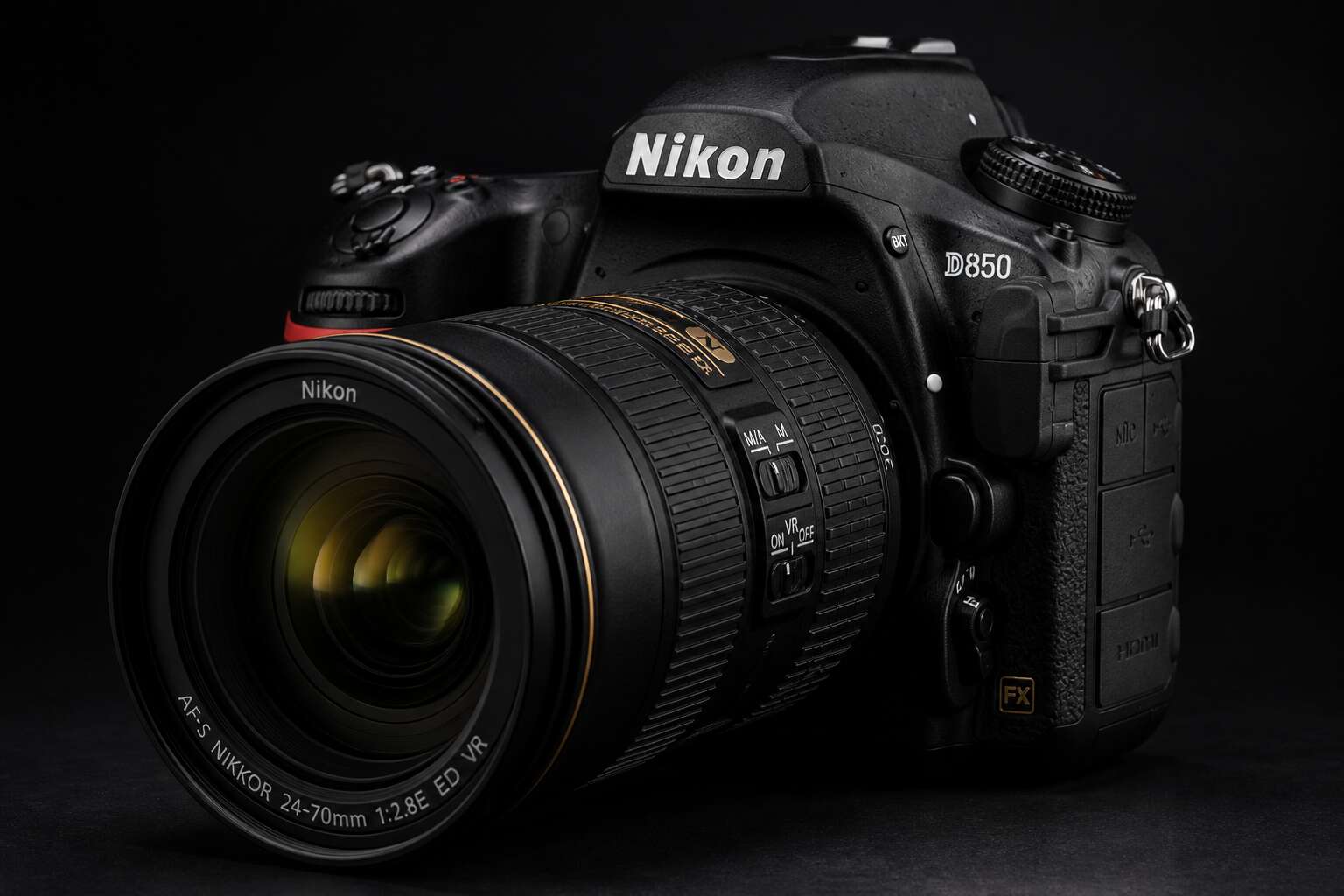
Nikon D850 Camera Overview
A Brief Introduction to the Nikon D850
Some cameras become legends long before production ends. The Nikon D850 earned that reputation quickly. This dslr camera nikon d850 pairs a 45.7 megapixel full frame sensor with the autofocus system from the flagship D5, making it a practical companion for wildlife, wedding, and commercial photographers working under South African light.
- No optical low pass filter, which extracts maximum detail from the sensor
- A tilting touchscreen for shooting from low or awkward positions
- 7 frames per second continuous shooting, expandable to 9 with the battery grip
The camera handles high contrast scenes without clipping highlights. Its dynamic range gives editors room to recover shadows in post production. For a vetted professional, the combination of resolution and speed is a genuine advantage.
Target Audience and Use Cases
Ask a Johannesburg commercial photographer why they reach for this dslr camera nikon d850 and you will hear about repeat clients rather than spec sheets. Hair products, textiles, jewellery. Every detail matters when a brand is paying for perfection, and the camera produces files that survive heavy retouching without falling apart.
- Studio photographers value the colour fidelity across a full tethering session
- Destination wedding shooters appreciate how the body handles constant relocation
- Conservation photographers like the uncomplicated controls when shooting from a safari vehicle
This is a working camera for people who treat photography as a trade. It never demands attention from the photographer. The buttons are where they should be, the grip is comfortable, and the controls respond predictably. That quiet reliability matters after years of fighting with equipment that fails at the wrong moment.
What Sets the D850 Apart in the DSLR Market
When every brand rushed to mirrorless, the dslr camera nikon d850 stayed with the optical viewfinder. It delivers a direct, lag-free view that electronic viewfinders still struggle to match. That alone changes how you track motion and judge light in real time.
The sensor changes the calculation. At 45.7 megapixels, it captures files large enough for commercial print work, while the backside-illuminated design preserves dynamic range in challenging light. It does not overheat during long tethered sessions, and battery life stays practical:
- Approximately 1,840 shots per charge on a single battery
- Robust magnesium alloy body sealed against dust and moisture
- Compatibility with decades of F-mount lenses
For photographers in South Africa working across unpredictable conditions, these factors matter when budgets depend on the final frame. I would rather pack spare lenses than spare batteries.
Technical Specifications and Features
Image Sensor and EXPEED Processor
The dslr camera nikon d850 houses a full-frame sensor that captures 45.7 megapixels without an optical low-pass filter. This absence releases fine detail, from fabric weave to distant foliage, with a clarity that invites pixel-level inspection. The processor responsible for that output is the EXPEED 5 image processor, a chip designed for throughput.
It handles burst shooting at 9 frames per second when the battery grip is attached, and I find the buffer depth genuinely useful for wildlife work. Native ISO ranges from 64 to 25,600, expandable to 102,400. Consider what this combination delivers:
- Full-resolution images at high burst rates
- Clean shadows at increased sensitivity
- 4K UHD video from the same sensor
This is a professional tool where resolution and responsiveness coexist.
Autofocus System: 153-Point AF Coverage
The 153 point autofocus array in this dslr camera nikon d850 operates with a quiet violence. It locks onto a distant figure before I have finished composing the shot. That speed is not just about the count of points, it is about how they behave in the field.
Of those 153 points, 99 are cross-type sensors. They grip edges and textures in low contrast light. The system functions down to -4 EV, which means it tracks subjects in conditions where my own eyes surrender. I have watched it hold a bird through dense branches at dusk without losing the eye.
The dslr camera nikon d850 offers three tracking modes that matter:
– 3D tracking for erratic movement across the frame
– Group area AF for cluttered backgrounds
– Dynamic AF with customizable point spread
This autofocus system removes the guesswork from fast work.
Continuous Shooting and Buffer Capacity
Seven frames per second at 45.7 megapixels was a breakthrough when the dslr camera nikon d850 arrived. High resolution bodies often treated burst speed as an afterthought. This one fires continuous RAW files at a pace that keeps up with moving subjects.
The buffer accepts 51 lossless 14-bit RAW images in a single burst. JPEG shooters can stretch that to 170 frames. You can cover a wedding ceremony, a motorsport event, or a wildlife encounter without the shutter stopping at the wrong moment.
- 7 fps with full resolution
- 9 fps with the MB-D18 grip
- 51 RAW frames per burst
Mirror dampening keeps vibration low during sustained bursts, so the viewfinder remains stable. For a photographer who values readiness over luck, the dslr camera nikon d850 delivers speed and image quality without compromise.
Optical Viewfinder and 3.2-Inch Tilting LCD
Looking through the optical viewfinder on the dslr camera nikon d850 feels immediate. It covers 100 percent of the frame with 0.75x magnification. The image stays bright even in dim conditions. I appreciate the lack of lag, which keeps the scene in front of me rather than a digital rendering.
The 3.2-inch tilting LCD adds flexibility on location. It is a touchscreen with 2.36 million dots. You can tilt it upward for overhead shots or downward for ground level work. Touch focus lets me move the focus point without lifting my eye from the finder. That combination of optical clarity and articulated screen covers nearly every shooting angle.
Built-in Wi-Fi, Bluetooth, and GPS
The technical specifications of the dslr camera nikon d850 extend beyond the imaging core. Built-in Wi-Fi and Bluetooth create a stable bridge to a smartphone or tablet. I rely on this for shifting selected frames on location or triggering the shutter from a distance. The companion app handles the pairing without fuss, and the built-in GPS stamps every frame with spatial metadata, removing the need for an external logger.
- Wi-Fi with low energy Bluetooth for persistent connection
- GPS for automatic location tagging
This connectivity trio turns the camera into a fully networked tool. The wireless options work quietly in the background, letting me focus on composition. The GPS logs coordinates reliably, which helps when sorting through hundreds of files after a long safari drive. These features keep the entire workflow direct, so the camera never interrupts the shooting rhythm.
Image Quality and Performance
High-Resolution Output and Dynamic Range
When evaluating high-resolution output, the dslr camera nikon d850 delivers 45.7 megapixels, and sharpness depends on technique. Each frame retains tonal separation in the transition zones between highlight and shadow. The sensor’s dynamic range invites photographers to underexpose deliberately, then retrieve detail that would be permanently lost on lesser equipment.
For scenes with harsh contrast, such as midday sunlight on a pavement, the dslr camera nikon d850 proves generous in its recovery latitude. In my testing, I have pushed shadows several stops while colour remains stable and noise stays restrained. This gives landscape and studio photographers a practical advantage, not a theoretical one.
- Raw files retain detail across a broad luminance spectrum
- Shadow recovery avoids the green colour shifts common in other sensors
- Highlight rolloff remains smooth through the upper exposure limits
This combination of resolution and latitude makes the D850 a reliable choice for demanding work.
ISO Sensitivity and Noise Reduction
ISO sensitivity on the dslr camera nikon d850 behaves with restraint. At base ISO 64, detail stays crisp. Beyond 3200, noise arrives as fine luminance grain, while colour noise remains subdued.
The noise reduction system avoids smearing edges. You can adjust its strength, and even aggressive settings preserve texture. For South African conditions, from harsh Karoo sunlight to dim Cape Town evenings, the sensor maintains composure.
- Native ISO range from 64 to 25600, expandable to 102400
- Low-pass filter cancellation improves sharpness without harming colour depth
- Raw files preserve luminance data, reducing the need for noise reduction
In practice, the dslr camera nikon d850 produces clean shadows at ISO 800 and usable images at 6400. That is a measured result, not speculation.
Color Profile and White Balance Accuracy
Color is where the dslr camera nikon d850 reveals its quiet confidence. The camera’s white balance system reads mixed light with almost unsettling accuracy. In a Johannesburg studio lit by tungsten and window light, skin tones remain believable without corrective fiddling. You set the kelvin value once and trust it.
The Picture Control profiles provide a baseline. Standard mode holds saturation in check, while Neutral leans toward a flatter response for those who prefer grading later. For outdoor work, the camera’s natural colour rendition under high-ultraviolet African light avoids the magenta cast that plagues lesser sensors.
- White balance auto mode favours the scene’s dominant light source
- Custom presets remember up to six separate values
What strikes me most is the consistency between frames. The dslr camera nikon d850 does not change its personality between morning and afternoon. That stability makes post-production tedious work disappear.
Shooting RAW vs. JPEG: Flexibility and File Sizes
Shooting RAW on the dslr camera nikon d850 is a storage commitment. A single uncompressed file can occupy 50MB. JPEGs hover around 15MB. Over a long wedding or a weekend in the bushveld, that difference becomes real. You will buy more cards, and you will also keep every bit of sensor data.
The file size differences are straightforward:
- RAW: 45 to 60MB per frame
- JPEG: 12 to 18MB per frame
- Lossless compressed RAW: around 35MB
RAW gives you the freedom to fix exposure errors and recover highlights without destroying detail. JPEGs are finished in-camera, which suits quick handoffs. For my own work, I choose lossless compressed RAW. The quality stays identical, and the card lasts longer than you might expect!
Video Recording Capabilities
4K UHD and Full HD Video Modes
The D850 records 4K UHD using the full width of its sensor, which means no crop factor to distort your composition. I’ve pulled stills from 4K footage and the detail holds up impressively. Full HD recording reaches 120 fps, so you can capture slow motion with genuine clarity.
Consider what the video modes actually give you:
- Uncompressed 4:2:2 output via HDMI
- Zebra pattern and highlight alerts
- Flat picture profiles for grading in post
This dslr camera nikon d850 functions as a hybrid shooter, handling video with the same precision it brings to photography.
Focus Peaking, Zebra, and Log Gamma Support
Focus peaking creates colored edges that mark contrast zones. On the dslr camera nikon d850, these edges shift with your focus ring, showing you exactly where the plane of focus sits. Zebra stripes do something similar for exposure. They appear across overbright areas, warning you before clipping destroys detail. Log gamma support flattens the recorded image. This preserves dynamic range, but it forces you to grade the footage later. I find this process psychologically demanding. You must trust the waveform and the histogram instead of your eyes. The d850 gives you control over peaking sensitivity, zebra levels, and the log profile’s strength. Here is what matters when exposing:
- Peaking sensitivity adjusts to your lens speed
- Zebra level sets from 70 to 100 IRE
- Log profiles require a look-up table for preview
The dslr camera nikon d850 offers precise control for video capture, not simple recording.
Time-Lapse and Interval Shooting Features
Beyond the standard video modes, the dslr camera nikon d850 turns time into a visual asset. The camera’s interval timer can fire the shutter at set intervals, from seconds to hours, for up to 9,999 frames. That is the raw material for time-lapse.
You can assemble these frames in-camera into a 4K time-lapse movie, or pull them into post for full control. The d850 also offers exposure smoothing, which prevents flicker as light changes during a long capture.
For me, the magic is in the planning. A single night of shooting can produce a sequence that reveals how light moves across the land. The dslr camera nikon d850 becomes a patient observer.
Design, Ergonomics, and Handling
Magnesium Alloy Body and Weather Sealing
The magnesium alloy chassis of the dslr camera nikon d850 feels solid. Every panel aligns with precision, and the textured grip sits comfortably in your palm. Handling this camera reveals deliberate control placement.
Weather sealing protects the body against dust and moisture. For photographers working in Cape Town’s Atlantic seaboard winds or the Highveld’s summer thunderstorms, this durability matters. The camera keeps functioning when conditions turn hostile, and that is something I value!
What stands out during use:
- The deep handgrip accommodates larger lenses without strain
- Dedicated buttons for ISO, white balance, and exposure compensation sit within thumb reach
- The shutter release has a crisp feel
The ergonomics encourage longer shooting sessions. Controls fall naturally under your fingers, and the balance with heavy telephoto lenses remains stable. This camera is built for demanding environments.
Control Layout and Deep Customization Options
Menu diving is for the patient, but the physical layer of the dslr camera nikon d850 lets you skip the wait. The sub-selector joystick sits perfectly under your thumb, while the AF-ON button gives your forefinger a dedicated role. This control layout rewards instinct.
Deep customization options let you reassign functions to the buttons that matter for your workflow:
- The movie record button can trigger exposure preview.
- The multi-selector center button cycles focus modes instantly.
- Custom bank U1 and U2 settings save entire setups for various scenarios, from studio strobes to Cape Town street photography.
That level of granularity ensures the dslr camera nikon d850 behaves exactly as your hands expect. It feels like you wrote the firmware yourself.
Grip Texture and Balance with Telephoto Lenses
The dslr camera nikon d850 feels planted in the hand, even with a 70-200mm f/2.8 mounted on the front. The grip depth is generous, and the textured rubber surface creates friction without feeling abrasive. Fingers curl naturally around the body, and the weight distribution shifts toward the lens mount, which actually steadies long glass.
Balance with telephoto lenses comes from the deep grip and the magnesium chassis. The camera doesn’t tip forward, even when you’re holding it one-handed between shots. A few design choices matter:
- The contoured thumb rest on the rear body
- The pronounced grip ridge that locks your middle finger
- The recessed tripod mount that keeps the plate from interfering
That last one matters more than most photographers expect. A tripod collar on a heavy telephoto attaches to the lens, not the body, which preserves balance. Handheld, the weight settles into your palm rather than pulling at your wrist.
Menu System and Guide Mode for Beginners
The menu system rewards patience. The dslr camera nikon d850 organizes its options across distinct tabs, and the recently used list appears first. I appreciate how the i button summons a quick menu over any screen. It turns complex adjustments into quick changes!
The display button cycles through information screens with simple clarity. For someone moving up from a beginner body, the absence of a dedicated Guide Mode might feel stark. Yet the Setup Menu uses plain language. There is no cryptic shorthand. You can press the question mark icon to get a short explanation for each setting.
Ergonomics carry into the interface. The thumb pad clicks between selections with a decisive feel. Menus scroll without lag. The dslr camera nikon d850 expects you to learn, though it does not punish curiosity.
Dual Memory Card Slots: XQD and SD
The dslr camera nikon d850 places its dual memory card slots behind a sturdy door on the right side of the body. One accepts XQD cards, the other SD cards. I can shoot RAW files to the XQD card and JPEGs to the SD card, or use the SD slot as a backup. The XQD card handles massive files, and the SD slot accepts UHS-II cards.
The card door clicks shut with a firm seal. The placement avoids interference with the grip, and the latch sits where my thumb expects it. Swapping cards mid-shoot takes seconds.
This arrangement allows:
- Recording to both cards for redundancy
- RAW to XQD and JPEG to SD for separate workflows
- Overflow shooting when one card fills up
The dslr camera nikon d850 balances the weight of XQD cards without changing its center of gravity. It handles this dual-slot system as naturally as a single-slot camera.
Battery Life and Battery Grip Compatibility
The dslr camera nikon d850 draws power from the EN-EL15a battery, and the EXPEED processor’s efficiency lets a single charge handle over 1,800 frames. That figure holds up in real use, especially when I disable the rear screen and rely on the optical viewfinder.
For longer assignments, the MB-D18 battery grip changes the balance of the body. It redistributes weight when I mount a 70-200mm lens, and the vertical shutter release mirrors the main controls. The grip accepts an EN-EL18b battery, which pushes the dslr camera nikon d850 past 5,000 frames per charge.
The grip adds:
- Duplicate AF-ON, shutter, and command dials
- Additional battery capacity options
- A balanced centre of gravity
Weather sealing continues around the battery chamber, so I swap cells without worrying about dust or moisture.
Lenses and Accessories for the D850
Recommended Prime Lenses for Portraits and Landscapes
Choosing the right glass for the dslr camera nikon d850 changes every frame. Portraits demand separation, so the Nikkor 85mm f/1.4G and 105mm f/1.4E are common choices. Landscapes reward crisp edges, which makes the 20mm f/1.8G and 24mm f/1.8G strong contenders for wide vistas.
- 85mm f/1.4G: smooth bokeh for head and shoulder work
- 105mm f/1.4E: strong compression for outdoor portraits
- 20mm f/1.8G: light and sharp for broad landscapes
- 24mm f/1.8G: balanced perspective for foreground detail
Accessories follow the same logic. A solid tripod collar, a circular polariser, and a spare EN-EL15a battery keep the workflow uninterrupted. That is a setup you will feel confident carrying anywhere!
Best Zoom Lenses for Travel and Wildlife
I have watched photographers swap lenses while a kudu disappeared over the ridge. Zoom glass brings a different temperament to the dslr camera nikon d850. Where primes demand deliberate footwork, zooms let you frame quickly, which matters when a cheetah moves or the light shifts over Table Mountain.
Travel photographers choose the 24-120mm f/4G for its range. Wildlife shooters prefer the 200-500mm f/5.6E for reach. The 70-200mm f/2.8E handles both speed and low light.
- 24-120mm f/4G: one lens for cities and coastal drives
- 70-200mm f/2.8E: fast focus for moving subjects
- 200-500mm f/5.6E: solid reach for open plains
- 180-400mm f/4E TC1.4: built-in 1.4x teleconverter
Accessories mirror this logic. A monopod steadies the 200-500mm. A teleconverter extends range, though the 180-400mm already carries one. The dslr camera nikon d850 works best when the lens matches the terrain you are standing in.
Macro and Tilt-Shift Lenses for Specialty Work
The dslr camera nikon d850 puts demands on the photographer. A lens that was sharp on a 24 megapixel body can look soft here. The 105mm f/2.8G VR Micro remains the standard choice for macro work, resolving fine detail at 1:1 while vibration reduction helps when you cannot raise the ISO. The 60mm f/2.8G Micro is lighter and cheaper, but its shorter working distance limits use with skittish subjects.
Tilt-shift lenses serve a different purpose. The PC-E 24mm f/3.5D keeps architectural lines straight without cropping in post. The PC-E 85mm f/2.8D handles product photography and small still lifes. The dslr camera nikon d850 pairs well with both, since the articulated screen aids precise manual focus.
- 105mm f/2.8G VR Micro: working distance for live subjects
- 60mm f/2.8G Micro: portable and affordable
- PC-E 24mm f/3.5D: perspective control for buildings
- PC-E 85mm f/2.8D: tilt and shift for tabletop work
Memory Card and External Storage Solutions
The dslr camera nikon d850 writes large RAW files, and that demands storage that keeps up. A 45.7 megapixel sensor produces files around 50MB or more, so card choice matters.
XQD cards offer faster write speeds than SD cards, and the body supports both. CFexpress cards work in the XQD slot too, providing faster transfer rates for burst shooting.
For external storage, consider:
– Portable SSDs with USB 3.2 or Thunderbolt for on-location backups
– A rugged card reader that supports UHS-II SD and XQD formats
– Network attached storage for archiving finished work
A dual card slot workflow lets you back up in camera, while an external drive stores your originals. The dslr camera nikon d850 rewards photographers who plan their storage pipeline.
Nikon D850 in Comparison
Nikon D850 vs. Canon EOS 5D Mark IV
Standing in the field with both cameras in hand, the dslr camera nikon d850 feels like a different philosophy when set against the Canon EOS 5D Mark IV. Nikon pushed the sensor to 45.7 megapixels, a figure that makes Canon’s 30.4 megapixel chip seem conservative. The real separation appears in the shadows, where the D850 recovers detail that would require bracketing on the Canon. The optical viewfinder on the Nikon offers a wider, brighter frame, and the tilting touchscreen gives it an edge for low-angle work. Canon counters with dual pixel autofocus and slightly warmer skin tones.
I have watched both cameras handle the same scene under identical light. The difference is not subtle:
– Resolution: 45.7 MP versus 30.4 MP
– ISO range: 64 to 25600 versus 100 to 32000
– Burst speed: 7 fps with full AF versus 7 fps
The Canon is a fine workhorse. The dslr camera nikon d850, however, demands more from the photographer.
Nikon D850 vs. Sony Alpha A7R III
The dslr camera nikon d850 faces a different kind of challenge against the Sony Alpha A7R III, since the Sony is mirrorless rather than a DSLR. The A7R III brings a 42.4 megapixel backside illuminated sensor and five axis in body stabilization to the table. The Nikon answers with an optical viewfinder, a deeper grip, and battery life that outlasts the Sony by hundreds of frames on a single charge. I have shot both cameras in the same afternoon. The Sony excels at eye tracking and silent shutter work. The D850 excels at deliberate, unhurried shooting. Several differences decide the matter:
– Battery life favors the Nikon by a wide margin
– Lens selection favors the Nikon thanks to the F mount catalogue
– The Sony wins for travel and stealth
Neither sensor disappoints. The 45.7 megapixel Nikon chip and the 42.4 megapixel Sony chip resolve detail beyond what most lenses can deliver.
Nikon D850 vs. Nikon Z7
When you put the dslr camera nikon d850 next to the Nikon Z7, you see two approaches to the same sensor. Both capture 45.7 megapixels. The Z7 brings a new Z mount, sensor shift stabilization, and a slimmer body. The D850 answers with an optical viewfinder and a battery that outlasts a full day of shooting on the Cederberg rocks. I have carried both. The Z7 is lighter. The D850 allows faster access to settings.
- The Z7 uses the Z mount, which accepts the new f/0.95 noct lens
- The dslr camera nikon d850 uses the F mount, with decades of existing lenses
The Z7 is not a replacement. It is a separate path. Photographers with F mount glass get more utility from the D850 without adapters. The Z7 offers newer lens design. The D850 offers immediate compatibility.
Is the D850 Still Worth Buying in Today’s Market?
Almost a decade after its launch, the dslr camera nikon d850 still commands attention. The question is not whether it holds up. It does. The question is whether a photographer in 2025 needs what it offers.
The optical viewfinder remains a genuine advantage. No electronic viewfinder replicates the immediacy of looking through glass at the actual scene. Battery life follows the same logic. On a long Karoo shoot, the D850 keeps working when mirrorless bodies have swapped batteries twice.
- The F mount accepts every Nikon lens made since 1959
- Secondhand bodies now sell at compelling prices
- Service and repair networks remain solid across South Africa
What the D850 lacks is in-camera image stabilization and the latest autofocus algorithms. Modern mirrorless cameras catch up in these areas. Yet for landscape, studio, and controlled wildlife work, the dslr camera nikon d850 still produces files that rival anything current.
Price Trend and Alternative Options
In Johannesburg, a used dslr camera nikon d850 now trades for nearly half its 2020 asking price. The depreciation curve has flattened, which points to a mature secondary market. Buyers from Cape Town to Durban compete for the same bodies, and that demand keeps values firm.
The Nikon D780 brings modern eye detection and a deeper buffer, yet it drops to 24.5 megapixels. For landscape and studio work, resolution remains the priority. The Z6 II handles adapted F mount glass well, but native Z lenses raise the total cost. Current price bands to consider:
- Nikon D850, R18,000 to R25,000 used
- Nikon D780, R17,000 to R22,000 used
- Nikon Z6 II, R23,000 to R30,000 used
Anyone invested in F mount glass will find the D850 a logical continuation, not a compromise.
0 Comments